When procurement managers and project planners ask how long a transformer will last, the standard answer is 25 to 35 years. But that figure assumes ideal conditions — proper installation, regular maintenance, correct load management, and protection from environmental stress. In practice, transformers in many parts of North East India operate under far from ideal conditions, and their actual lifespan reflects it.
Understanding what shortens — and what extends — transformer life is one of the most valuable pieces of knowledge any facility manager, DISCOM engineer, or procurement officer can have. This guide walks through the science and the practical reality of transformer lifespan.
The Baseline: What Determines a Transformer’s Design Life?
A transformer’s design life is primarily determined by the thermal life of its insulation system — specifically, the cellulose paper used to insulate the windings. As the insulation is exposed to heat, moisture, and oxygen over time, the degree of polymerisation (DP) value drops. When DP falls below 200, the insulation becomes mechanically brittle and loses its ability to withstand electrical stress. This is the end of a transformer’s usable life.
Typical Lifespan by Operating Condition
Operating Condition | Expected Lifespan | Key Risk Factor |
|---|---|---|
Ideal (regular maintenance, correct loading) | 30–35 years | Minimal |
Normal (some maintenance, moderate load) | 20–28 years | Occasional overloading |
Poor (little maintenance, frequent overload) | 10–15 years | Insulation degradation |
Harsh environment (flooding, high humidity, no care) | 8–12 years | Moisture ingress, corrosion |
Post-refurbishment (full overhaul) | +10–15 years | Depends on core condition |
Factors That Shorten Transformer Life
1. Overloading
Every transformer is rated for a specific kVA capacity. Operating a transformer at or near 100% of its rated capacity continuously generates significant heat. Each 8–10°C rise in average winding temperature above the rated limit roughly halves the insulation’s remaining life — a principle known as the Arrhenius thermal ageing rule.
In many industrial facilities and DISCOM networks across Assam, transformers are routinely overloaded during peak hours, festivals, or when load growth outpaces infrastructure upgrades. This is one of the leading causes of premature transformer failure in the region.
2. Poor Oil Quality and Lack of Oil Maintenance
Degraded transformer oil loses its insulating and cooling properties. Moisture in the oil — even in parts per million concentrations — dramatically reduces dielectric breakdown voltage. Oxidation products coat the windings and core, reducing heat dissipation. The result is a transformer that runs hotter, ages faster, and fails earlier.
3. Environmental Stress
Transformers in North East India face some of the harshest environmental conditions in the country. Annual flooding, extreme humidity levels (often above 80% year-round), salt-laden air near river basins, and rapid temperature cycling all accelerate corrosion, moisture ingress, and insulation breakdown.
Without proper surface coating, sealed conservators, and regular weatherproofing maintenance, outdoor transformers in this region can age at nearly twice the rate of those in drier climates.
4. Inadequate Protection Systems
Transformers without functioning Buchholz relays, pressure relief devices, or overcurrent protection are far more likely to suffer catastrophic damage when an internal fault occurs. Protection devices are designed to disconnect the transformer before a minor fault becomes a major failure. Faulty or bypassed protection is a life-shortening risk that is completely preventable.
5. Harmonic Distortion from Non-Linear Loads
Modern industrial facilities increasingly use variable frequency drives, UPS systems, rectifiers, and other non-linear loads that introduce harmonic currents into the network. These harmonics cause additional heating in transformer windings and cores beyond what standard load calculations assume. Transformers not rated for harmonic-heavy loads age faster than expected under these conditions.
Factors That Extend Transformer Life
Regular Preventive Maintenance
The single most impactful factor in extending transformer life is a structured preventive maintenance programme. This includes annual oil testing (BDV, DGA, acidity), insulation resistance measurements, winding temperature monitoring, cooling system inspection, and external cleaning.
Studies consistently show that transformers with documented maintenance histories outlast unmaintained units by 10–15 years or more.
Load Management
Keeping average loading below 70–75% of rated capacity significantly reduces thermal stress. Installing power monitoring systems and managing peak loads through demand response or load scheduling keeps transformers well within their comfort zone and slows ageing considerably.
Timely Refurbishment
A transformer approaching the end of its design life does not always need full replacement. Complete overhauls — including rewinding, core inspection, tank reconditioning, and fresh oil filling — can extend a transformer’s service life by another 10–15 years at a fraction of replacement cost.
How to Assess Your Transformer’s Remaining Life
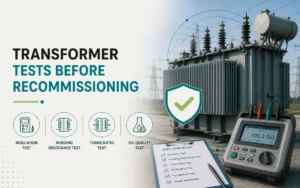
Remaining useful life can be assessed through a combination of oil DGA, insulation resistance (IR) and polarisation index (PI) tests, winding resistance measurement, degree of polymerisation test of insulation paper samples, and physical inspection of all components.
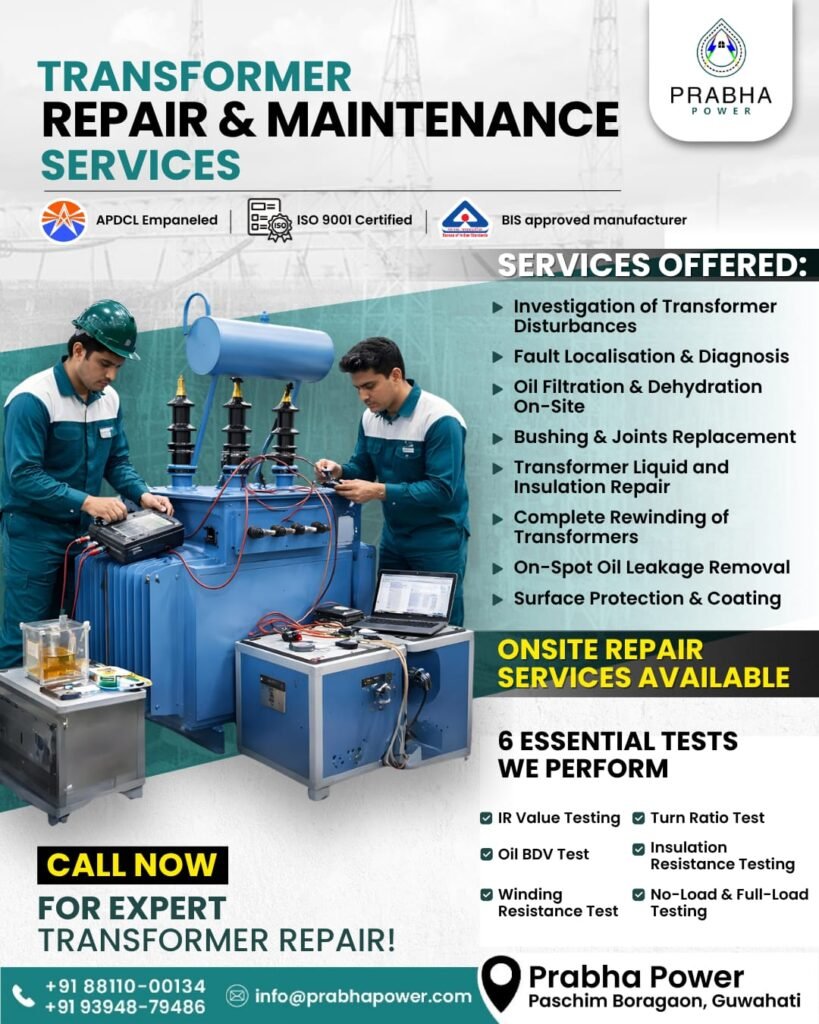
Prabha Power provides comprehensive transformer health assessments across Assam and North East India. Our engineers use these diagnostics to give you an accurate picture of your transformer’s condition and a clear recommendation on maintenance, refurbishment, or replacement.
The Bottom Line
The question ‘how long does a transformer last?’ really has two answers: the theoretical design life of 25–35 years, and the actual life it achieves based on how it is maintained and operated. With proper care, transformers frequently exceed 30 years of reliable service. Without it, they can fail in under 10.
If you are procuring a new transformer, build maintenance into your budget from day one. If you are managing an existing fleet, schedule a health assessment today.
Contact us: +91-9394879486