When a transformer develops a fault, facility managers and utility engineers face an immediate decision: should the unit be repaired on-site, or transported to a workshop? This decision has significant implications for cost, downtime, risk, and the quality of the final repair.
In most parts of India, workshop repair is assumed to be the standard. But in North East India — where road infrastructure is challenging, distances are long, and heavy transformer transport is expensive and logistically complex — on-site repair is often not just preferable, but the only practical option.
This guide compares both approaches honestly, so you can make the right call for your specific situation.
On-Site Transformer Repair: What It Involves
On-site repair means bringing qualified engineers and all necessary equipment to the transformer’s location — rather than moving the transformer. Prabha Power operates a dedicated mobile repair unit stocked with diagnostic tools, oil filtration equipment, rewinding materials, test instruments, and replacement components.
On-site repair is suitable for a wide range of fault types: oil leaks and gasket failures, bushing replacement, tap changer servicing, oil filtration and replacement, external surface cleaning and coating, insulation resistance testing, cooling system repair, and rewinding of smaller distribution units.
Advantages of On-Site Repair
No Transport Risk or Cost
Transformer transport — especially for units above 100 kVA — involves cranes, flatbed trucks, permits, and careful handling to avoid damage to bushings, conservators, and tank fittings. In the hilly, flood-prone terrain of Assam, Meghalaya, Arunachal Pradesh, and Nagaland, this transport can be extremely costly and slow.
Significantly Reduced Downtime
Transporting a transformer to a workshop can take days, depending on location and road conditions. Workshop queue times add further delay. In total, workshop repair in North East India can mean 2–6 weeks of transformer downtime. On-site repair can often begin within 24–48 hours of fault diagnosis and be completed in days.
Lower Overall Cost for Many Fault Types
When you factor in crane hire, transport charges, insurance during transit, and the extended rental or capital cost of replacement power during downtime, workshop repair is frequently more expensive than its quoted price suggests. On-site repair costs are generally transparent and all-inclusive.
Workshop Repair: When It Is the Right Choice
Workshop repair is best suited for transformers with major internal faults, large power transformers, or units where the economics of on-site repair are not favourable. In a workshop environment, technicians can perform complete core and winding disassembly, use precision rewinding machines, apply vacuum-pressure impregnation (VPI) processes, run high-voltage routine tests in a controlled environment, and inspect and repair the tank under clean, enclosed conditions.
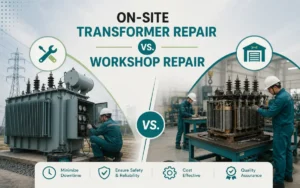
On-Site vs. Workshop Repair: Full Comparison
Decision Factor | On-Site Repair | Workshop Repair |
|---|
Best suited for | Oil leaks, bushing/gasket replacement, oil filtration, tap changer faults, minor winding repairs | Major winding failures, core damage, large power transformers |
Timeline | 1–5 days | 2–6 weeks (including transport) |
Total cost | Lower — no transport or crane cost | Higher — transport, crane, and queue time |
Transport risk | None — transformer stays in place | Real risk of bushing or conservator damage |
Recommissioning | Simple — same site, same connections | Full remounting and re-earthing required |
Availability in NE India | High — Prabha Power mobile unit | Limited — few certified workshops in region |
Suitable MVA range | Up to ~2 MVA distribution units | All ratings, especially above 2 MVA |
Core/winding overhaul | Partial repairs possible | Full disassembly and precision overhaul |
The North East India Context: Why On-Site Repair Matters More Here
Consider a scenario common in Assam: a 200 kVA distribution transformer serving a tea estate in Jorhat develops an oil leak and the BDV drops to 20 kV during monsoon season. Transporting the transformer to Guwahati and back involves a 400 km round trip over partially flooded roads, crane hire at both ends, and 3–4 weeks of downtime during the production season.
Prabha Power’s mobile on-site team can reach Jorhat, assess the fault, perform oil leak repair, replace gaskets, run on-site oil filtration to restore BDV above 60 kV, and conduct full pre-recommissioning testing — all within 2–4 days, at a fraction of the workshop repair scenario’s total cost.
Making the Right Decision
Still unsure which approach suits your transformer? Call Prabha Power for a no-obligation consultation. Our engineers will assess the fault type, your location, your timeline, and give you an honest recommendation — even if the answer is workshop repair.
Contact us: +91-9394879486