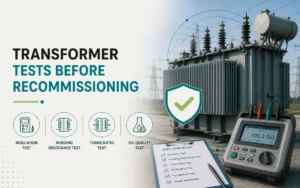
Re-energising a transformer without proper testing after a repair is one of the most dangerous shortcuts in electrical engineering. It can result in immediate transformer failure, damage to connected equipment, power outages, and serious safety hazards.
Before any repaired transformer is returned to service, it must pass a series of standardised diagnostic tests. These tests verify that the repair has been completed correctly, that no new defects have been introduced during servicing, and that the transformer is safe to operate at rated voltage and load.
At Prabha Power, recommissioning testing is a non-negotiable part of every repair assignment. This article explains the six essential tests our engineers perform — and why each one matters.
Why Recommissioning Tests Are Non-Negotiable
A transformer that has been opened, oil-drained, or rewound has had its internal environment disturbed. Even if the repair itself was executed flawlessly, reassembly can introduce: moisture into oil or insulation, loose connections at terminals, incorrect tap changer positions, air pockets in oil-filled spaces, and mechanical stress on windings during reassembly.
Testing before recommissioning catches these issues in a controlled, low-risk environment — rather than discovering them under full load, which can cause catastrophic failure.
The 6 Essential Pre-Recommissioning Tests
Test 1: Insulation Resistance (IR) Test
The insulation resistance test — commonly called the Megger test — measures the resistance of the insulation between the transformer’s windings and between the windings and the tank. It is performed using a high-voltage DC test instrument (typically 5 kV for HV windings).
Minimum acceptable IR values depend on the transformer’s voltage rating and ambient temperature. As a general rule, insulation resistance should not fall below 1 MΩ per kV of rated voltage. Low IR values indicate moisture contamination, insulation damage, or carbon tracking. Prabha Power also performs the Polarisation Index (PI) test alongside IR — a PI above 2.0 is generally considered acceptable.
Test 2: Dielectric Breakdown Voltage (BDV) Test of Oil
Before the transformer is sealed and energised, a sample of the oil must be tested for dielectric breakdown voltage. The BDV test determines the voltage at which the oil fails as an electrical insulator.
For distribution transformers, the minimum acceptable BDV is 30 kV per IS 335 standards, with a target above 60 kV for oil in good condition. If BDV is below standard, the oil must be filtered or replaced before the transformer is energised.
Test 3: Turns Ratio (TTR) Test
The turns ratio test verifies that the ratio of the number of turns in the primary winding to those in the secondary winding matches the transformer’s design specifications. This ratio directly determines the output voltage.
After winding repairs or tap changer servicing, an incorrect turns ratio can result in overvoltage or undervoltage supply to connected loads. The measured ratio must match the nameplate ratio within ±0.5% at each tap position tested.
Test 4: Winding Resistance Test
The winding resistance test measures the DC resistance of each winding — HV and LV — at all tap positions. This test verifies the integrity of the winding conductors and detects any loose or broken internal connections. Significant deviation from factory values indicates incomplete repairs or poor connection quality. Results are temperature-corrected to a standard reference temperature for accurate comparison.
Test 5: Vector Group Verification
Transformers are designed to produce specific phase relationships between primary and secondary voltages — described by their vector group (e.g., Dyn11, YNyn0). This is critical when the transformer is being connected in parallel with other transformers or integrated into an existing network.
After any major repair involving rewinding or connection modifications, the vector group must be verified. Incorrect vector group connection can result in circulating currents, equipment damage, and protection relay misoperation.
Test 6: No-Load Loss and Exciting Current Test
Also called the open-circuit test, this measurement is taken with the LV winding open-circuited and rated voltage applied to the HV winding. It measures no-load (core) losses in watts — which should match factory nameplate values within ±15% — and exciting current as a percentage of rated current, typically below 2–5% for distribution transformers.
Elevated no-load losses or abnormally high exciting current after repair can indicate core damage, shorted laminations, or incorrect core reassembly.
Pre-Recommissioning Test Summary
|
Test |
What It Checks |
Minimum Acceptance Criteria |
Relevant After |
|---|---|---|---|
|
Insulation Resistance (IR) |
Winding insulation quality |
≥1 MΩ per kV; PI ≥ 2.0 |
Any repair opening the tank |
|
BDV of Oil |
Dielectric strength of oil |
≥30 kV (target ≥60 kV) |
Oil filtration or replacement |
|
Turns Ratio (TTR) |
Correct winding ratio |
Within ±0.5% of nameplate |
Winding or tap changer work |
|
Winding Resistance |
Conductor & connection integrity |
Within ±2% of factory values |
Winding repair or reassembly |
|
Vector Group Verification |
Phase relationship accuracy |
Must match nameplate group |
Any major internal repair |
|
No-Load Loss & Exciting Current |
Core magnetic circuit health |
Within ±15% of nameplate |
Core repair or reassembly |
Additional Tests for Specific Repair Types
Depending on the type of repair performed, Prabha Power may also conduct Dissolved Gas Analysis (DGA) after oil replacement to establish a baseline, short circuit impedance test to verify winding geometry, temperature rise test for high-load applications, and partial discharge measurement for transformers above 1 MVA.
Documentation and Certification
Every pre-recommissioning test conducted by Prabha Power is documented in a formal test report, including all measured values, acceptance criteria, test instrument calibration references, and the engineer’s sign-off. This report forms part of the transformer’s maintenance record and is provided to the client.
Prabha Power’s Recommissioning Process
Whether a transformer has been repaired at our Guwahati workshop or serviced on-site at a remote location across North East India, Prabha Power follows the same rigorous recommissioning protocol. Our test equipment is calibrated, our engineers are trained to IS and IEC standards, and every report we issue is backed by our professional commitment. We do not return a transformer to service until it has passed every required test.
Contact us: +91-9394879486