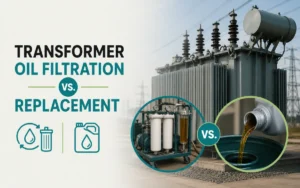

One of the most frequent questions Prabha Power receives from plant maintenance managers and DISCOM engineers is this: Should we filter the transformer oil, or replace it entirely? It sounds simple, but the answer depends on multiple factors — the oil’s current condition, the transformer’s age and load history, and the cost implications of each approach.
This guide breaks down the differences clearly, explains exactly when each option is appropriate, and helps you make the right decision for your transformer’s long-term health.
The Role of Transformer Oil
Transformer oil — also called insulating oil or dielectric oil — performs two critical functions. First, it provides electrical insulation between energised components inside the tank. Second, it acts as a coolant, absorbing heat generated by the windings and core and dissipating it through the tank walls and cooling fins.
Over time, transformer oil degrades due to thermal stress, moisture absorption, oxidation, and contamination from solid particles or metal deposits. As oil quality declines, both its insulating and cooling capabilities diminish — which is why monitoring and maintaining oil quality is a fundamental part of transformer care.
How Oil Condition Is Measured
Before deciding between filtration and replacement, you need to know the actual condition of your oil. The three primary tests are:
- Breakdown Voltage (BDV) Test: Measures the voltage at which the oil fails as an insulator. New oil should have a BDV above 60 kV. Oil below 30 kV is considered unsafe for continued operation.
- Acid Number Test: Measures oil acidity, which increases as the oil oxidises. An acid number above 0.30 mg KOH/g typically indicates the oil has degraded significantly.
- Dissolved Gas Analysis (DGA): Detects gases dissolved in the oil that indicate specific fault conditions such as partial discharge, overheating, or arcing inside the transformer.
Prabha Power performs all three tests as part of its oil condition assessment service across Assam and North East India.
What Is Transformer Oil Filtration?
Transformer oil filtration — also called oil purification or oil reconditioning — is the process of removing moisture, dissolved gases, particulate matter, and oxidation byproducts from the existing oil without replacing it entirely.
Modern filtration systems use vacuum dehydration technology to pull moisture and dissolved gases out of the oil under pressure. The process typically runs through multiple filter stages to remove particles down to very fine levels. The result is oil that is clean, dry, and restored to a usable dielectric strength.
When Is Filtration the Right Choice?
- BDV is between 30–60 kV (degraded but recoverable)
- Oil is light amber or slightly dark but not sludgy
- Acid number is below 0.3 mg KOH/g
- The transformer is relatively young (under 15 years)
- No evidence of internal arcing or serious fault gases in DGA
- Moisture content is elevated due to environmental exposure rather than chemical breakdown
Filtration is typically 40–60% cheaper than full oil replacement and can restore oil to near-new condition when performed by a properly equipped service provider. Prabha Power operates dedicated mobile oil filtration units capable of on-site treatment — eliminating the need to transport the transformer to a workshop.
What Is Transformer Oil Replacement?
Transformer oil replacement involves completely draining the existing oil from the tank, cleaning the internal surfaces, and refilling with fresh, tested transformer oil that meets IS 335 or IEC 60296 specifications.
This process is more involved and more expensive than filtration, but it is sometimes the only appropriate option.
When Is Oil Replacement Necessary?
- BDV has fallen below 30 kV and cannot be recovered through filtration
- Acid number exceeds 0.3 mg KOH/g — indicating heavy oxidation
- DGA shows active fault gases suggesting internal arcing or serious overheating
- Oil is black, sludgy, or has sediment that clogs filters
- The transformer has experienced a through-fault or fire event
- Internal surfaces show heavy carbon deposits requiring tank cleaning
Oil replacement also gives you the opportunity to inspect the internal condition of the transformer — checking for winding damage, sludge deposits on core laminations, and bushing condition — before resealing.
Filtration vs. Replacement: Side-by-Side Comparison
|
Factor |
Oil Filtration |
Oil Replacement |
|---|---|---|
|
Cost |
Lower (40–60% of replacement cost) |
Higher (full drain, clean, refill) |
|
Time Required |
Faster — same-day on-site possible |
Longer — includes draining, cleaning, refilling |
|
Best BDV Range |
30–60 kV (recoverable oil) |
Below 30 kV or unrecoverable |
|
Acid Number |
Below 0.3 mg KOH/g |
Above 0.3 mg KOH/g |
|
Oil Appearance |
Amber or slightly dark, not sludgy |
Black, sludgy, or with sediment |
|
Transformer Age |
Best for units under 15 years |
Recommended for units 20+ years |
|
After Fault? |
Not suitable for post-fault oil |
Required after arcing or fire event |
|
Internal Inspection |
Not included |
Tank inspection possible during drain |
|
Transport Required? |
No — done on-site by mobile unit |
May require workshop for full service |
Can Filtration Extend the Life of Old Oil Indefinitely?
No. Filtration removes moisture and particles but cannot reverse chemical degradation of the oil’s molecular structure. Once oil has oxidised past a certain threshold, filtration can improve BDV temporarily, but the oil will degrade faster than new oil. In these cases, replacement is the economically sound decision over the long term.
A good rule of thumb: if your oil has been filtered more than twice and continues to show high acidity or low BDV after filtration, it is time for full replacement.
Making the Right Call With Prabha Power
At Prabha Power, we don’t recommend filtration or replacement based on assumptions. Our team performs on-site oil testing before advising on any course of action. This ensures that every decision is based on actual data — not guesswork.
Our services include on-site BDV, acidity, and DGA testing; mobile vacuum oil filtration suitable for transformers up to 10 MVA; complete oil draining, tank cleaning, and fresh oil refilling; and post-service testing to confirm restoration of dielectric strength.
Whether your transformer needs filtration, replacement, or a combination of both, Prabha Power delivers the solution quickly and professionally — from Guwahati to the most remote corners of North East India.
Speak with our team: +91-9394879486